

The Circle Effect
making the ending look back at the beginning

For a few weeks now I’ve been meaning to write about what I call “the circle effect.” In the simplest terms, the circle effect is when the last line, last paragraph, or last part of a written piece points back to the first line, paragraph, or part. This is done through an image or a metaphor or a phrase, and the effect is that at the very end of the piece we are reminded of the beginning, which creates a circle effect, like the piece is still going on. As if it is cyclical, like the seasons, or the sun coming up every morning.
This week I wrote the piece below for my other page, Melt With Me. It’s an example of the circle effect. Take a moment and read it:
My Grandson’s Dinosaurs Will Save Us
My grandson’s mind is filled with wild imaginings. He’s three, which means he’s constantly uncovering new worlds. He tells me triceratops is taller than a tree. He says shadows can come unstitched. The scrap of woods behind my mother’s house harbors yet a few last wolves, he says, though not in such certain terms.
I humor him when I can, like the last time I visited and he said he was planning on driving me home. He can’t see over the wheel and his chubby little legs won’t reach off the seat, but there he was, like the self-assured man he might become, imagining himself steering me toward a country he’s never seen. Like a sailor on the sea. Like a Conestoga wagon heading west, not someone who recently learned how to walk.
Some days he gets me involved in his weirdness. While playing detective he holds his hands to his temples to pretend he’s looking for clues, then tells me to do the same. He asks permission to use the garden hose to put out an imaginary fire. He draws abstract images with sidewalk chalk he claims are mountains but look more like molehills to me.
Now, in my own wild writing, I see him grow up to be an imaginer. I bet he becomes a man who builds beauty. Who sees worlds no one else suspects because he maintains his child mind. Who puts words or images or ideas together in a way that means something to someone across the oceans of America, its vast and insufferable disinterest, and this brings me comfort.
See, you don’t remember this but one day you grew up and left your stories behind. You stopped imagining triceratops. You stopped wishing for T-rex to appear and started populating spreadsheets. You forgot about all the lost civilizations to explore in the woods behinds our houses and instead got lost yourself in the day-to-day drudgery of modern America.
And now here you are, late middle life, thinking of the wild imaginings of a child and wishing you could return. Which means here you are trying to buy what you already own. Trying to recapture what you’ve only forgotten—that dinosaurs still live and dream in the minds of children; that wolves still howl in the dark woods behind our houses; that imagination is a land we once loved, and any time we return our supper will still be waiting for us.
Notice how the last paragraph looks back at the same themes as the first: grandson, dinosaur, wolves, imagination. There is also the circle effect of childhood—a grown man looking at his grandson. It creates nostalgia, that sense of wanting to return.
The circle effect also gives the impression of a writer in full control. That this piece is perfectly thought out and executed. I love to see all the elements of a piece come together, like how Chief Broom uses the water fountain to escape in One Flew Over the Cuckoo’s Nest, after McMurphy teaches him he can pick it up.
Once you see it, you begin to see it everywhere. Look at the first and last lines of Watership Down:
First line: “The primroses were over.”
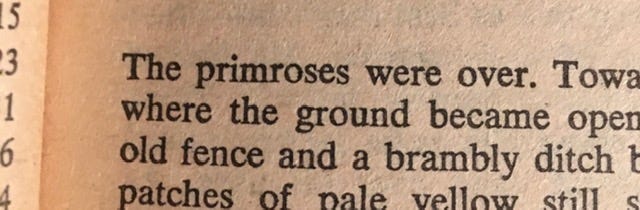
Last line: “Hazel followed; and together they slipped away, running easily down through the wood, where the first primroses were beginning to bloom.”
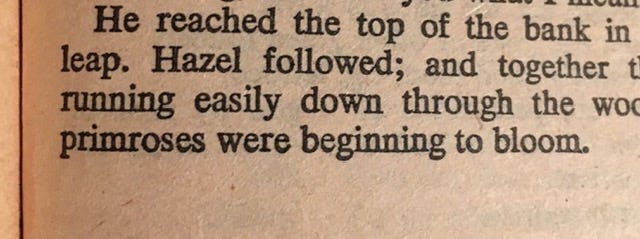
Hazel is dead in this scene. He is being led to rabbit-afterlife. But the primroses are blooming, which is a sign that Hazel’s warren (his people) will continue. The book begins with Hazel leaving the old warren, trying to find some safe place in a dangerous world; it ends with him finding the safe place. The primroses tell the reader that, and that the warren will continue without Hazel. And without us, because the book is over.
Another example is Scott Russell Sanders’ essay “At Play in the Paradise of Bombs.”
Here’s the first line: “Twice a man’s height and topped by strands of barbed wire, a chain-link fence stretched for miles along the highway leading up to the main gate of the Arsenal.”
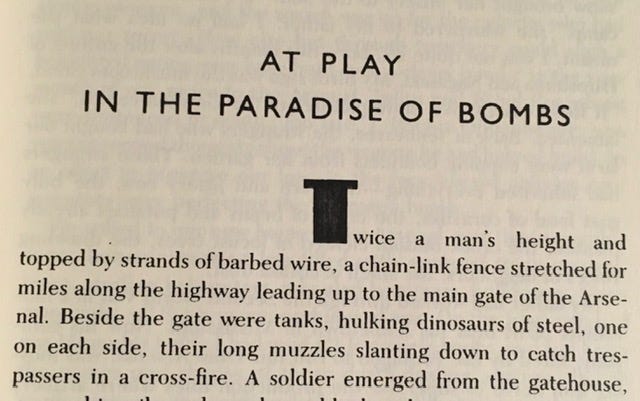
Sanders is a young boy when his family moves to the Arsenal, a bomb-making military facility in Ohio. The year is 1951, and the Arsenal is booming because of the Korean War. It’s a good move for his family, but Sanders, as a child, is scared of the fence. The fence becomes a symbol all throughout the essay—we see it again and again.
Now here’s the last two lines: “The fences of the Arsenal have stretched outward until they circle the entire planet. I feel, now, I can never move outside.”
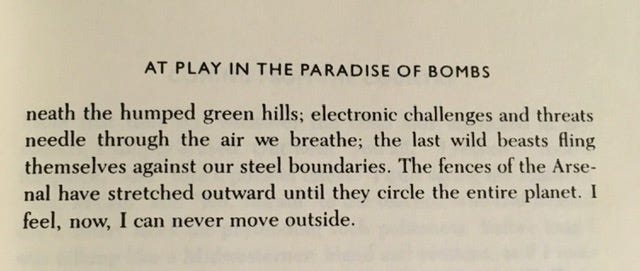
Sanders wrote the essay as a man looking back at his childhood. The first line is from the viewpoint of a child scared of the fence and the future, with its hulking dinosaurs of steel. The last line is a man telling us that he is still trapped inside that bomb-making military base because war gets inside you. Like fear. Like cancer.
One final example is Tim O’Brien’s short story of the Vietnam War, “The Things They Carried.”
The story starts, “First Lieutenant Jimmy Cross carried letters from a girl named Martha, a junior at Mount Sebastion College in New Jersey.” Cross opens the letters from Martha every day he is in Vietnam, but by the end of the story Lt. Cross burns the letters. After Lavender’s death, Cross gives up love, because he lives in a world of death. The letters represent hope, which was why he carried them, but now he burns them—he no longer has hope to get him through the war. This gives us the impression the war will always be there for him, even if he lives through it.
The circle effect is one of the reasons stories stay in our heads. We create them in conjunction with the writer’s descriptions. Good stories stay alive. They continue to exist far longer than the few hours we are reading them—they continue on forever inside us. Chief Broom escapes the mental facility, which means the Chief is still out there walking around, and that makes me happy. Lieutenant Jimmy Cross is eternally burning his letters in Vietnam, Hazel and Bigwig and Fiver are still alive on Watership Down, and three of Charlotte’s offspring stay with Wilbur at the end of Charlotte’s Web, so in my circular mind those three spiders still live in an old barn, talking to a grateful pig.
And they always will.
The circle effect is the Ouroboros worm eating its infinity tail. It tells us the story is still going on. It has always been going on, and always will be going on, which adds weight and heft and girth and substance to your writing. As if your story will continue in the minds of readers long after they’ve logged off.
Such a great lesson.
I love this. I hope someone has my old, creased Watership Down paperback. I just got interrupted by my husband talking about caladium plants and now I see a bunny peeking out from behind one in my mind's eye.